

Building an ecommerce store is about more than displaying products and processing orders. A well-designed store should also support the way a business operates behind the scenes.
For businesses selling furniture, appliances, or other large products, the purchasing process is closely connected to delivery and fulfillment. Information collected during checkout or product selection can directly affect how an order is handled.
Recently, we worked with a furniture retailer on a Shopify customization involving its White Glove Delivery service.
The request was straightforward: when customers selected this delivery option, the store needed to collect a few additional details.
It wasn’t a particularly complex development task. But it illustrated something we believe is important in ecommerce development: the best solution starts with understanding the business problem, not simply adding another feature.
The Challenge: A Delivery Option That Needed More Information
Our client offered two delivery options on its Shopify product pages: Standard Shipping and White Glove Delivery, a premium service involving additional delivery arrangements.
For standard shipping, the usual customer information was sufficient.
White Glove Delivery, however, required more preparation. The delivery team needed to know which floor the furniture would be delivered to, whether an elevator was available, and, when applicable, the customer’s apartment or unit number.
These details matter when arranging the delivery of large, heavy furniture.
The store already allowed customers to select their preferred delivery method. What it lacked was a way to request this additional information specifically from customers choosing White Glove Delivery.
Asking every customer to complete extra fields would create unnecessary friction. Relying entirely on general address fields was also not ideal, since those fields weren’t designed to communicate the specific requirements of this service.
The real challenge was to collect the right information without complicating the purchasing experience for everyone else.
Our Solution: Adapting the Product Page to the Delivery Process
Shopify’s native product variants allow merchants to offer different product options and prices. However, variant settings alone don’t automatically display additional required fields based on which option a customer selects.
Rather than redesigning the checkout process or introducing unnecessary complexity, we focused on the existing product page.
We developed a conditional form connected to the customer’s delivery selection.
When a customer selects White Glove Delivery, an additional section appears with three fields:
- Delivery Floor (Required): The floor where the furniture needs to be delivered.
- Elevator Availability (Required): Whether an elevator is available or the delivery requires using stairs.
- Apartment / Unit Number (Optional): Additional location details for customers living in apartments or multi-unit buildings.
When Standard Shipping is selected, the additional form is hidden, keeping the original purchasing process simple.
The customization was designed to let customers provide relevant information at the point where they choose their delivery service, rather than relying on the business to request those details separately.
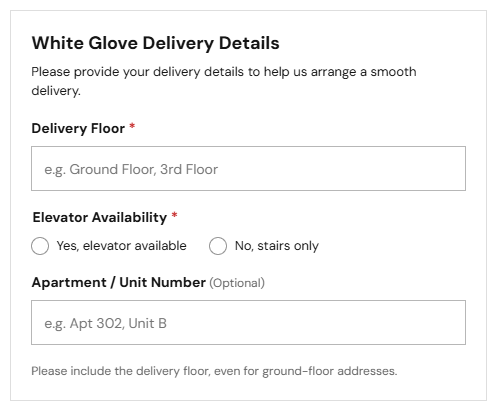
The updated product page displays the additional delivery fields when White Glove Delivery is selected.
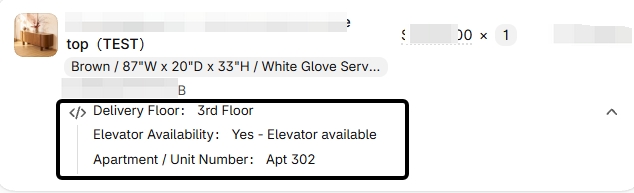
Test order in Shopify: Customer-provided White Glove Delivery details are displayed alongside the purchased item, making the information accessible to staff handling fulfillment.
From a development perspective, this involved a targeted customization of the Shopify product page rather than a complete redesign of the store.
The focus was on making the existing shopping experience better suited to the retailer’s delivery requirements.
Why a Small Customization Can Matter
At first glance, adding three input fields might seem like a minor change.
But the business problem behind those fields is more meaningful.
When a customer purchases a large piece of furniture, the order is only the beginning of the fulfillment process. The merchant still needs to arrange delivery, coordinate with service providers, and make sure the delivery team has the information required to complete the job.
If important details are missing, the business may need to contact the customer again before arranging the service.
Collecting relevant information earlier can help reduce that additional communication and support a smoother handoff between online orders and delivery operations.
Equally important, customers who don’t need White Glove Delivery aren’t asked to provide information that has nothing to do with their purchase.
The intention is simple: make the online purchasing process better reflect what happens after an order is placed.
Of course, this customization doesn’t replace the retailer’s delivery management process. Scheduling, logistics coordination, and customer communication still need to be handled properly.
But it addresses one specific gap between the standard online shopping experience and the merchant’s actual operational needs.
Good Shopify Development Starts With Understanding the Business
Shopify provides a strong foundation for ecommerce businesses. Its standardized features make it possible to build and manage online stores without developing every function from scratch.
However, businesses don’t all operate in the same way.
A furniture retailer may need detailed delivery instructions. An equipment supplier may need installation information. A business selling customized products may need to collect specifications before an order can be processed.
These requirements aren’t necessarily signs that the ecommerce platform is inadequate. They simply reflect the differences between real businesses.
And not every problem requires a large development project.
Sometimes an existing Shopify feature is enough. Sometimes a third-party application is the most practical choice. Other times, a focused customization can better address a specific need.
At Alauda Growth, we believe Shopify development should begin with understanding how a merchant runs their business.
That means looking beyond page layouts and feature lists to consider how customers place orders, how teams fulfill them, and where the online store can better support everyday operations.
Our White Glove Delivery customization is a small example of that approach.
The goal wasn’t to build something technically impressive. It was to address a practical requirement in the retailer’s purchasing and delivery process.
Because a well-built ecommerce store shouldn’t force a business to adapt to the website. The website should support the way the business works.